
Liberation from Addiction
At the heart of what we call addiction may be this fundamental misperception: that we are somehow separate from life itself, disconnected from the deeper source of peace, wholeness, and being already within us.

Recovering from Addiction and Dependency Attachments
What to do?
What do we do in a world where many of the most established and effective recovery programs offer remarkable support, community, accountability, and practical tools — yet may still leave untouched the deeper sense of separation, unworthiness, and incompleteness that so often fuels compulsive behavior?
Addressing the Primal Addiction
At the heart of what we call addiction may be a more fundamental misperception: the deeply conditioned belief that we are separate — separate from one another, from life, from God, from the Cosmos, and from the deeper wholeness of our own being.
In this sense, addiction can be understood not only as attachment to a substance, behavior, person, or experience, but as part of a broader human struggle with me-ness and otherness — the felt sense of being an isolated self searching outside itself for relief, completion, worth, or peace.
We could say that much of human suffering grows from this inner misunderstanding and misidentification. When we believe ourselves to be separate, incomplete, or fundamentally lacking, the search begins — and addiction can become one of the many ways we attempt to fill what feels missing.
Yes. We are Evolving in Many Ways
Human consciousness has evolved in extraordinary ways — too many to count. That is good news. We are beginning to recognize that we can consciously participate in our own evolution, or continue repeating self-defeating patterns rooted in fear, unworthiness, and separation while trying to make the impermanence of life somehow permanent.
Everything is changing. Everything is moving. And perhaps humanity itself is continually being invited toward greater awareness, compassion, and peaceful coexistence. Yet on the human level, we often struggle against the natural processes of biological, psychological, and spiritual transformation by becoming entangled in inherited stories, internal narratives, and imagined projections. We resist change by clinging to identities, self-images, and concepts of who we think we are — even when those identities are no longer helping us live freely. From this perspective, recovery is not only about stopping a behavior. It can also become a path toward Self-Realization beyond the illusion of separation.
This page is therefore an invitation to consider new possibilities in addiction recovery: first, the continued evolution of Twelve Step programs beyond some of the limitations of their original religious language and concepts; and second, the possibility of broader recovery models that integrate feeling, healing, awakening, self-inquiry, and spiritual discovery without requiring adherence to dogma, religious identity, or a fixed belief system.
Alternative Options for Healing and Liberation
Introducing Collective Healing Anonymous
In a world where suffering has become so familiar — where people struggle with addictions, obsessions, compulsions, coping patterns, dependency, and identity challenges — a profound evolution in recovery is emerging.
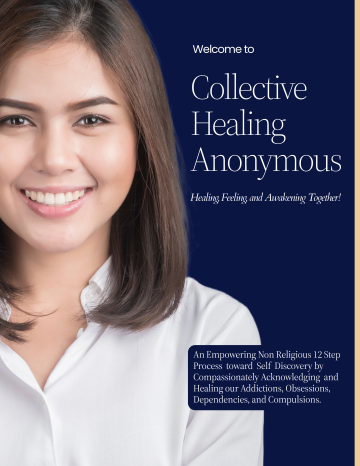
Collective Healing Anonymous (CHA) is a nonreligious yet deeply spiritual alternative recovery model designed to empower individuals to become free from the obsessions, compulsions, addictions, dependency patterns, and limiting identities that interfere with living fully and freely in this life. Drawing inspiration from the wisdom of traditional Twelve Step recovery while moving beyond some of its religious and conceptual limitations, CHA offers a process of feeling, healing, self-inquiry, awakening, and deep personal responsibility.
At the heart of CHA is a simple understanding: you are not alone. Human beings everywhere experience attachment, avoidance, compulsive thinking, emotional coping, and the search for relief in countless forms. This is not a program only for people who are considered “broken,” “addicted,” or in need of fixing. It is for anyone who freely chooses to explore greater inner freedom, conscious clarity, and liberation from the patterns that no longer serve them.
The deeper possibility is not merely learning to manage an addiction or substitute one coping mechanism for another. It is discovering a way of living with greater freedom from the underlying obsessions, compulsions, dependency patterns, and identity structures themselves.
Welcome to empowerment and self-liberation. Welcome to feeling, healing, and awakening.
What is Non-Duality Recovery?
There is a good chance you have heard of the Twelve Steps through programs such as Alcoholics Anonymous, Sex Addicts Anonymous, Overeaters Anonymous, or Al-Anon. Yet you may be less familiar with a growing alternative approach to recovery rooted in the understanding of non-duality.
There is a good chance you have heard of the Twelve Steps through programs such as Alcoholics Anonymous, Sex Addicts Anonymous, Overeaters Anonymous, or Al-Anon. Yet you may be less familiar with a growing alternative approach to recovery rooted in the understanding of non-duality.
The term non-duality points toward one of humanity’s most deeply conditioned misperceptions: the belief that there is a separate “me” existing apart from the whole of life. In many religious frameworks, for example, God may be imagined as something separate from humanity and the rest of existence. Non-dual teachings invite a different possibility — that separation is not the deepest truth of reality, but an appearance created through thought, identity, and conditioned perception.
Across history, many awakened spiritual teachers have pointed toward this deeper unity, and contemporary scientific inquiry has likewise continued to reveal the profound interconnectedness of life and the universe. From this perspective, the felt sense of being fundamentally separate, isolated, or incomplete may be something we have learned to believe rather than what we ultimately are.
And that is very good news. Because if the sense of separation is not absolute, then recovery can become more than managing symptoms or resisting urges. It can become an exploration of the deeper wholeness, freedom, and completeness already present beneath the patterns of addiction, obsession, compulsion, and dependency.
The God Concept is Evolving
For many people, the concept of God is evolving from the image of a distant “God out there” toward a more intimate understanding: that the sacred, divine, or universal source of life is not separate from us, but expressed through and within each of us. In this view, every person is a unique expression of the Universe, the Cosmos, or God itself.
That possibility is not always explored deeply within traditional Twelve Step recovery, where spiritual language can still carry inherited religious assumptions about a separate higher power. For some people, that framework remains meaningful and supportive. For others, it can feel limiting, outdated, or disconnected from their own direct experience.
At the same time, many people today are reexamining inherited religious beliefs, identities, and practices. Some continue participating in churches or spiritual communities while privately questioning ideas they were taught to accept. Others are discovering that their deepest spiritual questions are no longer adequately answered by traditional religious language alone.
These shifts invite more than simply replacing one belief system with another. They open the possibility of recovery beyond religious obligation and inherited concepts — toward direct experience, self-inquiry, inner transformation, and a deeper recognition of who and what we are beyond cultural conditioning and outdated traditions.
ALL Inclusive Addiction Recovery Options
Below are several possibilities that may go beyond what many people have previously been offered or encouraged to explore. One is the nonreligious recovery approach developed by Scott Kiloby through the Kiloby Center for Recovery. Another is an approach that can be incorporated alongside traditional Twelve Step recovery through Ester Nicholson and her book Soul Recovery: 12 Keys to Healing Addiction.
What makes these approaches especially compelling is their emphasis on addressing deeper causes of suffering and disconnection, rather than focusing only on the outward symptoms of addiction. Much of recovery understandably concentrates on stopping the behavior, substance, or compulsion itself. Yet beneath those symptoms may be a deeper condition of separation, misidentification, unresolved pain, and learned self-oppression that continues to seek relief.
From this perspective, chemical and drug dependence, codependency, sexual addiction, alcoholism, overspending, and other addictions, compulsions, and obsessions can be understood not only as problems to eliminate, but also as signals pointing toward something deeper within us that is seeking healing, wholeness, liberation, and conscious clarity.
Alternative Addiction and Dependency Recovery Options (videos) *
Everything You Wanted to Know about Addiction with Dr. Joe Dispenza
In this wide-ranging conversation, Dr. Joe Dispenza explores the nature of addiction, habitual behavior, emotional conditioning, and the ways deeply ingrained patterns can shape the mind and body. He offers a perspective on how greater awareness, intentional practice, and changes in habitual thought and behavior may support recovery and personal transformation.
This is one of the most compelling conversations we have encountered in more than 40 years of exploring addiction and recovery. It offers a fascinating perspective on why dependency patterns can become so deeply rooted — and how we may begin loosening their hold while opening to greater freedom, healing, and conscious choice.
Addiction Recovery with Dr. Joe Dispenza
The Direct Approach of Byron Katie during a 12 Step Meeting
Byron Katie offers a direct method of self-inquiry for questioning the thoughts, beliefs, and assumptions that can keep us caught in suffering. Her approach, known as The Work, invites us to look closely at the stories we believe and discover what remains when those stories are questioned.
In the video below, she brings this process into a Twelve Step setting, demonstrating how simple, honest inquiry can cut through layers of judgment, fear, and conditioned thinking while pointing toward the peace and clarity already present beneath them.
The Best of Healing with Byron Katie
Her free self-inquiry resources are available through TheWork.com.
“I promise, it is highly liberating. Check it out!” — Peace President
A Companion Approach for Working the 12 Steps
In Soul Recovery, Ester Nicholson offers a spiritual approach that can complement traditional Twelve Step recovery while moving beyond the idea of permanent powerlessness.
“The root concept that underlies Soul Recovery is that we actually are the power and the presence of Spirit in form. While powerlessness is an important stepping stone…our continuing happiness and spiritual development are dependent on releasing this idea of powerlessness. Sobriety and control – which is the primary focus of the 12 Step process – can only do so much. True happiness requires moving beyond control of addiction to the path of self-realization.”
— Ester Nicholson
Ester Nicholson: Soul Recovery
In the video below, Ester Nicholson shares the essence of Soul Recovery and explores how recovery can deepen beyond sobriety and behavioral control into healing, spiritual awakening, self-realization, and a more empowered relationship with ourselves.
Scott Kiloby on Nonreligious Addiction Recovery
In this illuminating video, Scott Kiloby explores a non-12-step, nonreligious approach to recovery that looks beyond addiction as merely a behavior to be controlled. He discusses the deeper emotional, psychological, and experiential patterns that can underlie addiction, trauma, anxiety, depression, and other forms of suffering, while pointing toward greater freedom through awareness, healing, and direct inner inquiry. Kiloby Center for Liberation
Other Addiction Recovery Resources & Communities
The Other Side Academy is a training school in which students learn pro-social, vocational and life skills allowing them to emerge with a healthy life on “the other side”. This program is available as an alternative to those facing long-term incarceration as well as those seeking a change from the life they’ve chosen in the past. Many of those who seek entrance into the Academy are convicts, substance abusers or homeless. This school accepts men and women, both pre-and post-sentencing, who are ready to learn a new and better way to live.
Genius Recovery is a safe place for those in recovery and those who support recovery, to connect, collaborate, and contribute. We share the mindset that recovery and addiction should be viewed with compassion, not judgement. We ask “Why the pain? Not, why the addiction.” This is hub to share experience, strength and hope, and a place where the world’s top recovery experts frequently share strategies and resources. Genius Recovery helps heal the pain, and saves lives.
* Note: The individuals, organizations, and resources featured on this page are not affiliated with Peace President United. Inclusion is for educational and informational purposes only and does not imply endorsement of PPU.